CardioAtlasANATOMY IN MOTION
Cardiovascular teaching atlas
THE HUMAN CIRCULATION

Follow the flow.

Explore the vessels. Understand the heart. Connect anatomy to the clinic.

—named vessel entries
4 connected circulations
SCHEMATIC 3D
RL
Whole-body circulationDrag to rotate · Scroll to zoom · Select a vessel
Oxygen-rich Oxygen-poor→ Flow direction

Colors indicate relative oxygenation, not artery/vein identity. Arrows show normal direction; particle speed is illustrative.

TRANSPARENT PROVENANCE

Sources & model notes

What this atlas is

The rotatable body map is an original, hand-authored teaching schematic. It is not a segmented CT/MRI dataset or a clinically validated anatomical reconstruction. Vessel positions, diameters and distances are simplified. It covers major named vessels, not every branch, capillary or anatomical variant.

Flow paths are ordered in normal physiological direction. White arrows remain visible when animation is paused. Particle speed does not represent velocity, pressure, pulse timing or measured perfusion. Arteries and veins are named by direction relative to the heart; color indicates relative oxygenation.

Paired tibial veins, palmar arches and pulmonary vein pairs are grouped. The intracranial arterial network, small visceral branches, capillaries, portosystemic collaterals and cardiac conduction system are not reconstructed. Coronary geometry shows one right-dominant pattern.

Artwork & software

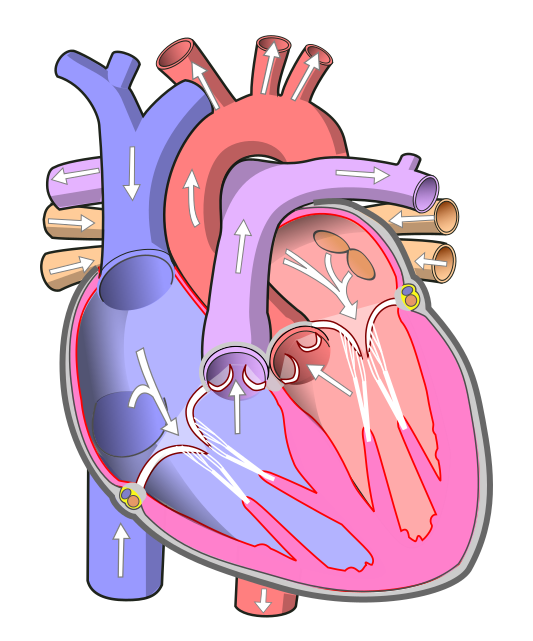
The heart cutaway is an independently licensed anatomical illustration by Wapcaplet, Yaddah and Wnauta, with later revisions by Jmarchn. The SVG is reproduced unchanged; interactive markers are added as a separate overlay. The plate and its presentation adaptations are licensed under CC BY-SA 3.0. No endorsement is implied.

The app and vessel coordinates were authored for this project. Three.js and OrbitControls are bundled under the MIT license. NeuroAxis inspired the exploratory format; its anatomical assets were not used. Clinical notes are teaching explanations, not individual diagnostic or treatment guidance.

Sources reviewed 10 October 2026. See attribution details and project source on GitHub.